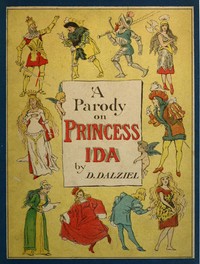
This parody transposes Gilbert and Sullivan's Princess Ida from a medieval castle to a Chicago railroad depot, where King Alton Hilderbrandt rules over the Chicago & Alton Line. The opening chorus immediately establishes the central concern: courtiers scan the tracks with telescopes for the overdue King Gama, whose train—a “special” placed at his disposal—has failed to arrive on time. The parody’s structure hinges on this delay, replacing the original’s courtly anticipation with railroad logistics.
Dalziel’s adaptation is not merely a setting swap; it systematically replaces the original’s chivalric language with railroad terminology. The “warriors three” become Arac, Guron, and Synthius, who sing of the Alton’s “splendid bed and track” rather than martial prowess. The movement between scenes follows the comings and goings of trains, with entrances announced by express services and departures by “special” cars.
Railroad as Stage Machinery
The parody’s plot is driven by train schedules. King Hilderbrandt’s opening speech notes that the regular train from Castle Adamant arrived “exactly on time,” but Gama’s special is late. This punctuality motif recurs: Hilderbrandt boasts that “all trains on the Alton Road invariably do come in on time,” a claim that the delayed special immediately contradicts. The stage directions treat the railroad as both setting and dramatic engine. Characters enter and exit via trains: Gama arrives on a private car, and later the Princess’s father follows on the “Denver Express.” The climax features an armed force arriving by “St. Louis express,” and the final confrontation is resolved not by sword but by the threat of the Alton’s efficiency.
Recurring Images of Observation and Surveillance
From the first chorus, characters are depicted “looking out on the line of the Chicago and Alton Railroad with telescopes, opera glasses, etc.” This image of scanning the tracks recurs throughout. Florian, who “has been looking attentively down the track with his glasses,” announces Gama’s approach by describing the smoke and “music of its wheels.” The parody replaces the original’s watchtowers and battlements with depot platforms and observation cars. Even the Princess’s castle is described as having a “castle window” overlooking the tracks. This visual motif reinforces the parody’s central joke: the romantic anticipation of a bride’s arrival is reduced to the mundane anxiety of a delayed train.
The Alton Line as a Character
The Chicago & Alton Railroad is not merely a backdrop but an active presence, personified and praised in song. The chorus declares “The Alton is a road, as such / None beat it,” and the captured warriors—Arac, Guron, and Synthius—reluctantly commend its service: “The Alton is a line to trust— / Confound it.” Even the villainous Gama, after being treated well, sings that “the Alton is delightful.” The parody transforms the original’s martial loyalty into corporate boosterism. The railroad’s attributes—punctuality, comfortable cars, efficient service—become the new chivalric virtues. Hilderbrandt’s threat of war is couched in terms of rival lines, and his army consists of “Chicago and Alton conductors, armed to the teeth.”
Movement Between Scenes: Trains as Transitions
The parody’s scene changes are marked by train arrivals and departures. The first scene ends with Hilderbrandt’s order to prepare both “the costliest of dinners” and “the deepest dungeon,” contingent on Gama’s compliance. The second scene shifts to the “Chicago & Alton Depot,” where Hilarion and his friends await. Later, the Princess’s castle is breached by an armed force arriving by express. The final scene includes Gama’s entrance “on the Denver Express.” This constant movement by rail creates a rhythm of anticipation and arrival, mirroring the original’s comings and goings but replacing royal processions with locomotive timetables. The parody’s structure thus mirrors the railroad’s own linear, scheduled nature.
Readers familiar with Gilbert and Sullivan’s Princess Ida will recognize the parody’s fidelity to the original’s plot structure and song forms, while newcomers can enjoy the absurdity of a kingdom run like a railroad company. Pay attention to how Dalziel repurposes the original’s lyrics: the “warriors three” become reluctant advertisers for the Alton Line, and Gama’s complaint song turns into a praise of the very railroad he should despise. The parody is best read as a period piece of 1880s American railroad culture, where corporate pride could be sung with the same fervor as patriotic duty.
Reading that Chicago railroad parody, I found myself smiling at how it turned Princess Ida’s lofty battle into a fuss about punctuality and a delayed train. It reminded me, oddly, of the lighter social warfare in The Belle's Stratagem — Text and Context—both feel like fond, knowing winks at ambitious women and stubborn men, caught in a dance that’s more charm than conflict. A quiet kinship, really.