About 403 minutes
Irish Plays and Playwrights — Reading Notes
Adventure Picaresque Fiction
92,671 recorded words. 133 minutes difference from this book's estimate.
View Gutenberg source #19028
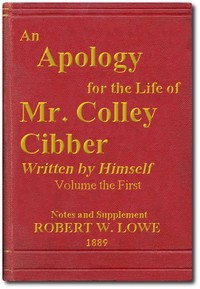
The source record for An Apology for the Life of Mr. Colley Cibber, Volume 1 (of 2) Written by Himself. A New Edition with Notes and Supplement — Themes and Context measures this digital text at 123,165 words, 8 hr 56 min estimated reading time, and 17 detected text sections.
The text analysis averages about 19.5 words per sentence, while the detected sections provide another way to judge how the source is divided.
Project Gutenberg metadata also associates the work with “Theater -- Great Britain -- History -- 18th century,” connecting these edition facts with the source record’s subject description.
Explore this collection
These alternatives are selected using recorded categories and estimated reading time.
About 403 minutes
Adventure Picaresque Fiction
92,671 recorded words. 133 minutes difference from this book's estimate.
View Gutenberg source #19028About 349 minutes
Adventure Picaresque Fiction
80,071 recorded words. 187 minutes difference from this book's estimate.
View Gutenberg source #20890About 255 minutes
Adventure Picaresque Fiction
58,584 recorded words. 281 minutes difference from this book's estimate.
View Gutenberg source #7228Search stored excerpts and compare books → Choose by your preferences →
Choices use stored catalog measurements. Estimates vary with reading speed. A shared category is a catalog label, not a claim that two books have the same argument or literary quality.
Search reads excerpt text stored with this catalog and links to its associated Gutenberg record. The connection is stored in the site database; this tool does not recheck that every excerpt is word-for-word identical to that external record. Excerpt search does not cover every chapter and does not verify historical publication dates.
Catalog snapshot checked: 2026-09-25. Coverage: 94 public books, 94 available source excerpts.
Read the complete public-domain text at its original source.
Read on Project GutenbergColley Cibber's Apology is less a straightforward life story than a sustained argument for his place in theatrical history. The excerpts show him wielding anecdote and character judgment as tools of self-justification, particularly in his detailed comparisons of actors Powel and Wilks. Cibber's voice is confident, even combative, as he dissects professional rivalries with the precision of a seasoned insider.
This edition, prepared by Robert W. Lowe in 1889, adds extensive notes and a supplement aimed at correcting Cibber's 'inaccuracy and vagueness' on matters of fact. The catalog subjects list theater history, biography, and management, but the excerpts themselves focus narrowly on actor behavior, stage discipline, and the politics of the patent company—revealing a gap between the book's generic classification and its actual content.
Cibber does not simply narrate events; he uses them to make points about professional virtue. In the extended account of the rivalry between Powel and Wilks, every detail serves a moral: Powel's 'unheedful Confidence' and habit of deferring study 'as School-boys do their Exercise' are contrasted with Wilks's 'constant wakeful Care' and perfect memory. Cibber even claims Wilks 'never lost an Hour of precious Time' and 'in forty Years he ever five times chang'd or misplac'd an Article.' The specificity is striking—Cibber is not just telling a story but building a case for diligence over natural talent.
His language is evaluative throughout: Powel 'miss'd a good deal of the loose Humour,' while Wilks 'gave the Town and the Stage sufficient Hopes.' The rivalry culminates in a challenge that 'ended in favour of Wilks,' but Cibber notes the animosity remained 'as deep in the Heart as ever.' These are not neutral records; they are carefully crafted judgments that bolster Cibber's own authority as a witness and arbiter of theatrical merit.
Despite the title's promise of a 'life,' the excerpts reveal almost nothing about Cibber's personal history—his family, education, or private experiences. Instead, the narrative is dominated by the professional sphere: the Drury Lane company, rival actors, and the patentee's favor. Cibber's 'Apology' is a defense of his career, not a confession or memoir in the modern sense. The catalog subjects list 'Theater -- Great Britain -- History -- 18th century' and 'Actors -- Great Britain -- Biography,' but the excerpts show that Cibber's biography is almost entirely subsumed by institutional history.
Even when describing a challenge between actors, Cibber frames it as a lesson in professional conduct: 'the different Conduct of these rival Actors may be of use to others of the same Profession.' The personal is always instrumental. Readers expecting intimate revelation will find instead a public argument about standards, reputation, and the proper management of a theatrical company.
Robert W. Lowe's preface makes clear that this edition aims to remedy Cibber's 'inaccuracy and vagueness' by providing 'an exhaustive commentary.' Lowe claims to have consulted manuscripts in the British Museum and the Lord Chamberlain's Office, giving 'exact dates of many transactions which were previously uncertain.' This editorial apparatus fundamentally changes the reading experience: the text is no longer Cibber's alone but a dialogue between his narrative and Lowe's corrections.
The excerpts do not include Lowe's notes, but his presence is felt in the preface's language of 'correcting errors' and 'elucidation.' The result is a hybrid work—part autobiography, part scholarly edition—that invites readers to compare Cibber's version with documented facts. This tension between the author's self-serving account and the editor's factual corrections is perhaps the most interesting feature of the volume, though the excerpts alone cannot show how fully Lowe's notes reshape the original.
Readers should approach this volume as a layered document: Cibber's original text, written to defend his reputation, and Lowe's annotations, written to correct it. The excerpts suggest that the most rewarding way to read is to attend to both voices—noticing where Cibber's anecdotes serve his argument and where Lowe's notes might challenge them. The catalog subjects point to theater history, but the real subject is the construction of a professional self through narrative.
I keep thinking about how Cibber couldn't stop talking about the other actors—their timing, their tempers—almost as if stagecraft were the only honest language he had. It reminded me of those quieter, older notes on Terence and Plautus, where the playwrights’ own voices feel strangely near. Prefaces to Terence's Comedies and Plautus's Comedies (1694) — Reading Notes sat with me the same way—less a story, more a whispered argument about how words should sound aloud.
Use these questions to collect your thoughts before moving on.









