
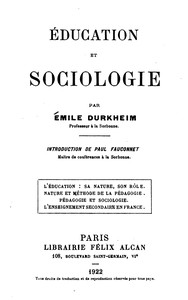
Éducation et sociologie by Émile Durkheim
Let's be clear: this isn't a novel. There's no plot twist on page 42. But the 'story' Durkheim tells is about one of the most powerful forces in our lives: the education system. He lays out a simple but radical idea. Education, from his view, isn't primarily for the individual child. Its main job is for society. Every generation needs a way to pass down its language, its morals, its sense of right and wrong, and its collective knowledge to the next generation. If it doesn't, society falls apart.
The Story
Durkheim walks us through this argument step-by-step. He starts by defining what education actually is—not just reading and math, but the whole process of shaping social beings. He then shows how different societies throughout history have used education to create the specific kinds of citizens they need. A warrior society educates for bravery and strength; an industrial society educates for cooperation and specialized skills. The 'characters' here are abstract—Society, the Individual, the Teacher—but the conflict is real. It's the constant tug-of-war between what society demands of us and who we might want to be as individuals.
Why You Should Read It
I picked this up thinking it would be a dry history of French schools. I was wrong. It's a lens that changes how you see the world. Suddenly, things like standardized testing, school uniforms, and even the stories we read in class look different. You start to see them not just as teaching tools, but as social tools. It made me question my own education: Was I taught to think, or was I taught what to think? Durkheim doesn't give easy answers, but he gives you the framework to ask better questions. It’s a short book, but you'll want to read it slowly, maybe a chapter at a time, to let the ideas sink in.
Final Verdict
This book is perfect for anyone who has ever been to school (so, everyone), but especially for teachers, parents, policy makers, or just curious people who want to understand one of the foundational structures of modern life. It's not a beach read, but it’s a brilliant, foundational text. If you've ever wondered why schools feel the way they do, Durkheim’s century-old ideas still provide some of the clearest and most challenging explanations.
There are no legal restrictions on this material. It is now common property for all to enjoy.
Mason Nguyen
1 year agoTo be perfectly clear, the author's voice is distinct and makes complex topics easy to digest. Absolutely essential reading.









Andrew Thompson
4 months agoBased on the summary, I decided to read it and the plot twists are genuinely surprising. Truly inspiring.