
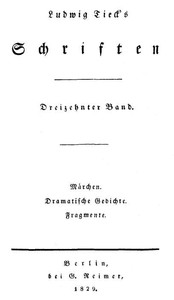
Schriften 13: Märchen; Dramatische Gedichte; Fragmente by Ludwig Tieck
Let's be clear: this isn't a single novel. 'Schriften 13' is a volume from Tieck's collected works, packed with fairy tales ('Märchen'), dramatic poems, and fragments. Think of it as a sampler platter of his most imaginative and influential ideas.
The Story
There's no one plot. Instead, you jump between different worlds. In one tale, you might follow a knight who becomes obsessed with a magical, possibly sinister, statue. In a dramatic poem, characters might debate the nature of art and love while surrounded by supernatural events. The fairy tales are the star—they have princes and witches and transformations, but they feel off-kilter. The logic is dreamlike. Characters are aware they're in a story, or the narrator might break in to comment. The 'fragments' section is especially cool; it's like peeking into Tieck's workshop, seeing brilliant ideas that were never fully finished.
Why You Should Read It
I love this book because it feels dangerous. Not scary-dangerous, but intellectually daring. Tieck wasn't just writing escapism; he was using fantasy to poke at big questions. What is real? Is emotion more true than reason? His characters are often artists, dreamers, or madmen—people who see more than everyone else, for better or worse. Reading him, you realize how much later writers, from E.T.A. Hoffmann to even modern magical realists, owe him a debt. He gave fantasy a brain and a nervous system.
Final Verdict
This is a book for a specific, curious reader. It's perfect for fantasy fans who want to explore the genre's deep, weird roots. It's great for anyone who loves German Romantic art and music and wants to see the literary side. It is not a light, before-bed read. The language is dense (it's a 19th-century German text, often in translation), and the ideas require your full attention. But if you're willing to sit with it, you'll find stories that are astonishingly fresh, creative, and deeply strange. It's a journey into the forest of the Romantic mind, and there's no map.
This content is free to share and distribute. You are welcome to share this with anyone.
Christopher Martin
2 years agoI came across this while browsing and it manages to explain difficult concepts in plain English. Exceeded all my expectations.
Noah Anderson
6 months agoSimply put, the emotional weight of the story is balanced perfectly. Absolutely essential reading.
Karen Williams
1 year agoComprehensive and well-researched.
Edward Allen
1 year agoGreat reference material for my coursework.
Michael Allen
1 year agoBased on the summary, I decided to read it and the character development leaves a lasting impact. Truly inspiring.