About 828 minutes
The Elizabethan Stage, Vol. 4 — Story, Setting & Ideas
Science Fiction Utopias
190,411 recorded words. 313 minutes difference from this book's estimate.
View Gutenberg source #69371
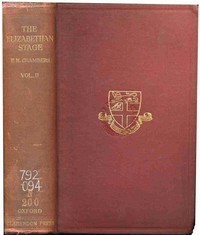
The catalog record for The Elizabethan Stage, Vol. 2 — Story, Setting & Ideas provides practical reading context through 262,340 words, 19 hr 1 min estimated reading time, and 49 detected text sections.
The text analysis averages about 18.7 words per sentence, while the detected sections provide another way to judge how the source is divided.
Project Gutenberg metadata also associates the work with “Great Britain -- History -- Elizabeth, 1558-1603,” connecting these edition facts with the source record’s subject description.
Explore this collection
These alternatives are selected using recorded categories and estimated reading time.
About 828 minutes
Science Fiction Utopias
190,411 recorded words. 313 minutes difference from this book's estimate.
View Gutenberg source #69371About 771 minutes
Science Fiction Utopias
177,298 recorded words. 370 minutes difference from this book's estimate.
View Gutenberg source #12218About 486 minutes
Science Fiction Utopias
111,615 recorded words. 655 minutes difference from this book's estimate.
View Gutenberg source #34214Search stored excerpts and compare books → Choose by your preferences →
Choices use stored catalog measurements. Estimates vary with reading speed. A shared category is a catalog label, not a claim that two books have the same argument or literary quality.
Search reads excerpt text stored with this catalog and links to its associated Gutenberg record. The connection is stored in the site database; this tool does not recheck that every excerpt is word-for-word identical to that external record. Excerpt search does not cover every chapter and does not verify historical publication dates.
Catalog snapshot checked: 2026-09-25. Coverage: 94 public books, 94 available source excerpts.
Read the complete public-domain text at its original source.
Read on Project GutenbergE. K. Chambers’s second volume of The Elizabethan Stage moves from the boy companies of Paul’s and the Chapel Royal to the adult troupes that dominated London’s theatrical landscape. The book’s structure is taxonomic: each company and playhouse receives a dedicated section, with evidence drawn from court records, wills, and contemporary accounts. Chambers does not narrate a continuous history but assembles a mosaic of documentary fragments, letting the archival record shape the reader’s understanding of how companies formed, dissolved, and migrated between patrons.
The volume opens with the boy companies, whose legal status as choristers or chapel servants gave them a distinct position. Chambers traces the Children of Paul’s from their early performances to their later rivalry with adult troupes, noting how patronage ties—such as those to the Queen or noble households—determined a company’s longevity. The adult companies are arranged by patron, from the Earl of Leicester’s Men to the King’s Men, with each entry detailing shifts in membership and touring routes. Chambers’s method is to collate payment records, license applications, and legal complaints, often letting the documents speak for themselves. For instance, the section on the Lord Admiral’s Men includes references to the Fortune contract, which specifies the dimensions and materials of the playhouse, a rare survival that illuminates building practices.
Book IV turns to the playhouses themselves, beginning with inns like the Red Lion and the Bull before moving to purpose-built structures. Chambers describes the Theatre, the Curtain, the Rose, the Swan, and the Globe, drawing on maps, building contracts, and lawsuits. The entry on the Globe includes details from the 1599 contract for its construction, noting that the timber was taken from the Theatre and reassembled on Bankside. Chambers also records the disputes over leases and shares that plagued playhouse owners, such as the conflict between the Burbages and Giles Allen. The private theatres, Blackfriars and Whitefriars, receive separate treatment, with emphasis on their indoor lighting, higher admission prices, and more select audiences. Throughout, Chambers anchors his descriptions in specific documents: the Fortune contract, the Hope’s dual purpose as a bear-baiting arena, and the legal wrangling over Porter’s Hall.
Chambers devotes a substantial section to individual actors, compiling biographical data from wills, parish registers, and court cases. The entry on Richard Tarlton is exemplary: Chambers quotes from his will, a Chancery dispute over its validity, and a death-bed petition to Walsingham. He also cites a contemporary account of Tarlton’s jests before the Queen, which led to his banishment from court. The actor’s posthumous reputation is tracked through pamphlets and ballads that exploited his name. Other actors, such as Edward Alleyn and William Kemp, receive similar treatment, with Chambers noting their financial dealings and family connections. The evidence is fragmentary—a lawsuit here, a baptism record there—but Chambers assembles it into a coherent picture of a profession that was both precarious and lucrative.
A brief section covers Italian players in England and English players abroad. Chambers records visits by Italian troupes, including a commedia dell’arte company that performed at court in the 1570s, and the travels of English actors to Scotland and the Continent. The entries are necessarily sparse, relying on diplomatic correspondence and municipal records. Chambers notes that English players in Germany and the Netherlands often adapted their repertoire to local tastes, performing plays by Marlowe and Shakespeare in translation. The section underscores the mobility of Elizabethan performers and the networks that connected London to provincial and foreign stages. Chambers does not speculate on the cultural impact of these exchanges but limits himself to documenting what the archives reveal: payments, licenses, and occasional complaints about unruly players.
Readers approaching this volume should treat it as a reference work rather than a narrative history. Chambers’s strength lies in his meticulous documentation; his weakness is a reluctance to synthesize. The index and cross-references are essential for navigating the dense entries. For those interested in a single company or playhouse, the relevant section can be read independently. The volume rewards patience: the details of a lawsuit or a building contract often illuminate larger patterns of patronage and competition that shaped Elizabethan drama.
That rainy afternoon, I kept returning to Chambers’s meticulous entries on the boy companies, their vanished laughter and legal squabbles. Somewhere between the patent disputes and the Globe’s timber, I remembered another kind of theatrical blunder—a quieter, colder one. I set the volume aside and found myself opening The Blunderer — Inside the Classic, and the rain seemed to change tempo, almost knowingly.
Use these questions to collect your thoughts before moving on.









