About 94 minutes
The Middle-Class Gentleman — Themes and Context
Historical Psychological Social Fiction
21,419 recorded words. 1 minutes difference from this book's estimate.
View Gutenberg source #2992
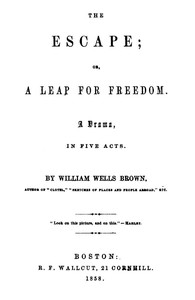
The source record for The Escape; Or, A Leap For Freedom: A Drama, in Five Acts — Text and Context measures this digital text at 21,748 words, 1 hr 35 min estimated reading time, and 9 detected text sections.
The text analysis averages about 13.2 words per sentence, while the detected sections provide another way to judge how the source is divided.
Project Gutenberg metadata also associates the work with “African Americans -- Drama,” connecting these edition facts with the source record’s subject description.
Explore this collection
These alternatives are selected using recorded categories and estimated reading time.
About 94 minutes
Historical Psychological Social Fiction
21,419 recorded words. 1 minutes difference from this book's estimate.
View Gutenberg source #2992About 101 minutes
Historical Psychological Social Fiction
23,114 recorded words. 6 minutes difference from this book's estimate.
View Gutenberg source #75666About 105 minutes
Historical Psychological Social Fiction
24,149 recorded words. 10 minutes difference from this book's estimate.
View Gutenberg source #1120Search stored excerpts and compare books → Choose by your preferences →
Choices use stored catalog measurements. Estimates vary with reading speed. A shared category is a catalog label, not a claim that two books have the same argument or literary quality.
Search reads excerpt text stored with this catalog and links to its associated Gutenberg record. The connection is stored in the site database; this tool does not recheck that every excerpt is word-for-word identical to that external record. Excerpt search does not cover every chapter and does not verify historical publication dates.
Catalog snapshot checked: 2026-09-25. Coverage: 94 public books, 94 available source excerpts.
Read the complete public-domain text at its original source.
Read on Project GutenbergWilliam Wells Brown's 1858 drama opens not with a grand plantation tableau but with a social blunder that lays bare the racial logic of the slaveholding household. Major Moore, mistaking the enslaved boy Sampey for Dr. Gaines's son, remarks on the child's resemblance to the colonel—only to be corrected by Mrs. Gaines: "That is one of the niggers, sir." The exchange, played for awkward comedy, instantly reveals how kinship, property, and color are policed in this world. Dr. Gaines's later aside—"If you did call him my son, you didn't miss it much"—adds a layer of knowing cruelty that the play will sustain through its five acts.
Brown crafts dialogue that does double duty: it advances the plot while exposing the power dynamics that characters dare not name directly. When Major Moore apologizes for his mistake, Mrs. Gaines replies, "No offence, sir; mistakes will be made," a line that simultaneously dismisses the incident and acknowledges the systematic confusion slavery produces. The enslaved characters speak in registers that shift between guarded deference and private anguish. Glen's soliloquy in act 1, scene 4, moves from conventional lament ("Oh, how I want to see Melinda!") to a startling assertion of intellectual equality: "Why was I born with a wish to be free, and still be a slave?" Brown gives Glen a vocabulary of rights—"thoughts, reason, taste, judgment, conscience and passions"—that the white characters never articulate. The contrast is deliberate: the slave speaks the language of liberty while the masters speak of property and appetite.
Brown uses stage directions and setting to map the geography of control. The play moves from Dr. Gaines's parlor (where Sampey is mistaken for a son) to a forest (where Glen voices his rebellion) to a "small cottage on the Poplar Farm" where Melinda is held prisoner. Each space enforces a different kind of captivity: the parlor enforces social performance, the forest allows temporary solitude, the cottage is a literal cage. Melinda's opening lines in scene 5 emphasize the clandestine nature of her removal: "Master took the opportunity, when Glen was in the city with his master, to bring me here to this lonely place, and fearing that mistress would know where I was, he brought me here at night." The repetition of "master" and the detail of nighttime transport underscore how the enslaved body is moved like cargo, with the law of the plantation overriding even the mistress's knowledge.
Brown includes a marriage ceremony that he claims in the preface "is still adhered to in many of the Southern States, especially in the farming districts." The scene, though not fully excerpted here, is described as a ritual that denies the enslaved couple legal recognition while mimicking Christian form. Brown's preface frames it as ethnographic evidence: he does not invent the ceremony but reports it from his own experience. This choice turns the drama into a documentary of sorts, using the stage to preserve a practice that white legal systems refused to acknowledge. The ceremony's inclusion also creates a structural irony: the play's title promises escape, but the first act binds the protagonists in a union that the law will not protect. Brown lets the ritual speak for itself, trusting the audience to recognize the gap between the ceremony's form and its legal nullity.
Brown populates the drama with a range of white characters—the speculator Dick Walker, the neighbor Mr. Wildmarsh, the overseer Jacob Scragg—whose speech patterns reveal the casual brutality of the slave economy. The preface notes that "the difficulties created in the domestic circle by the presence of beautiful slave women" is a theme drawn from Brown's own observations. Dr. Gaines's pursuit of Melinda, conducted in language that veers between cajoling and threatening, exemplifies this dynamic. When he tells her, "You know that I love you, and I have told you, and I tell you again," the repetition signals not affection but insistence, a refusal to accept refusal. Brown does not need to stage violence to make it felt; the threat is carried in the rhythm of the dialogue, in the way Gaines's sentences circle back on themselves, wearing down resistance through sheer verbal pressure.
Brown's preface insists that "the main features in the Drama are true" and that many incidents came from his own eighteen years enslaved in the South. Readers attentive to the play's verbal texture will find a work that uses the conventions of melodrama—soliloquy, mistaken identity, last-minute rescue—to document the psychological and social mechanisms of slavery. The drama rewards attention not only to what characters say but to how they say it: the pauses, the repetitions, the moments when a slave's eloquence shatters the master's complacency. Brown asks no favor for his play, but he gives readers a sharp-eyed record of a world where every word carries weight.
I often think of that leap in William Wells Brown’s drama—how escape meant claiming a self, not just fleeing ground. There is a quieter echo of that same reaching in Trelawny of The "Wells": A Comedietta in Four Acts — Background and Themes, where the stage holds its own small rebellions, less urgent, yet tender in their longing for personhood. They sit well together, those two.
Create a short personal record of your experience with this book.









