About 108 minutes
The Birds — Story, Setting & Ideas
Historical Psychological Social Fiction
24,654 recorded words. 0 minutes difference from this book's estimate.
View Gutenberg source #3013
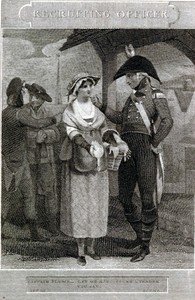
This digital edition of The Recruiting Officer — A Closer Reading is described by source-level measurements including 24,737 words, 1 hr 48 min estimated reading time, and 4 detected text sections.
The text analysis averages about 15.4 words per sentence, while the detected sections provide another way to judge how the source is divided.
Project Gutenberg metadata also associates the work with “English drama (Comedy),” connecting these edition facts with the source record’s subject description.
Explore this collection
These alternatives are selected using recorded categories and estimated reading time.
About 108 minutes
Historical Psychological Social Fiction
24,654 recorded words. 0 minutes difference from this book's estimate.
View Gutenberg source #3013About 106 minutes
Historical Psychological Social Fiction
24,282 recorded words. 2 minutes difference from this book's estimate.
View Gutenberg source #7279About 105 minutes
Historical Psychological Social Fiction
24,149 recorded words. 3 minutes difference from this book's estimate.
View Gutenberg source #1120Search stored excerpts and compare books → Choose by your preferences →
Choices use stored catalog measurements. Estimates vary with reading speed. A shared category is a catalog label, not a claim that two books have the same argument or literary quality.
Search reads excerpt text stored with this catalog and links to its associated Gutenberg record. The connection is stored in the site database; this tool does not recheck that every excerpt is word-for-word identical to that external record. Excerpt search does not cover every chapter and does not verify historical publication dates.
Catalog snapshot checked: 2026-09-25. Coverage: 94 public books, 94 available source excerpts.
Read the complete public-domain text at its original source.
Read on Project GutenbergFarquhar's The Recruiting Officer opens with a brisk, competitive energy as two captains, Plume and Brazen, vie to enlist a young man who calls himself Jack Wilful. The dialogue crackles with rapid-fire one-upmanship: Brazen offers a corporal's rank, Plume counters with a promise to make him a companion, and the recruit coolly declares, 'he that bids the fairest, has me.' This early scene establishes the play's central dynamic—recruiting as a theatrical contest of promises and bluffs—and introduces the serjeant Kite, whose loyalties are tested when he must physically carry Sylvia offstage to prevent a duel.
The first three acts, as Mrs. Inchbald's remarks note, are 'brilliant in wit, humour, character, incident.' The excerpt from Act I showcases Farquhar's ear for competitive banter: Plume and Brazen trade insults and boasts while Sylvia, disguised as a man, plays them against each other. The scene pivots on a mock duel that ends in an embrace, with Brazen declaring, 'I always fight with a man before I make him my friend.' This blend of aggression and camaraderie defines the recruiting officers' world. Inchbald observes that Farquhar, himself a recruiting officer, likely drew Plume from his own person and Kite from a real serjeant, grounding the comedy in observed behavior.
Inchbald's commentary flags Sylvia's disguise in boy's clothes as 'an improbable, and romantic occurrence,' yet notes it was accepted as natural in earlier drama. The excerpt shows Sylvia adopting the name Jack Wilful and claiming relation 'to all the Wilfuls in Europe,' a boast that lets her manipulate both captains. Her disguise drives much of the plot's intrigue, but Inchbald argues that English ladies of the period seldom concealed their sex by such means. Readers may observe how Farquhar uses the device to generate comic misunderstandings, even as it strains credibility.
Inchbald is blunt about the play's structural weakness: 'the decrease of merit in a play, on approaching its conclusion, is of most unfortunate consequence.' She attributes this to Farquhar's reliance on fortune-telling in the final two acts, a device she deems 'so dull' that it casts 'a heaviness upon all those scenes.' For modern readers, the shift from the sharp verbal sparring of the opening to supernatural gimmickry may feel jarring. Inchbald speculates that Farquhar, having exhausted his store of entertainment, was 'compelled to supply the bulk of the two last acts, from the scanty fund of wasted spirits.'
Farquhar dedicated the play 'to all friends round the Wrekin,' the hill near Shrewsbury, and thanked locals for their hospitality. Inchbald reports that he found the country folk—Rose, her brother, and the two recruits—'under the shade of that beforementioned hill,' suggesting he transcribed real speech and mannerisms. The play's setting is not mere backdrop but a source of its most 'excellently drawn characters.' Readers attuned to regional detail will note how the Shropshire milieu inflects the comedy, from the recruits' rustic simplicity to the officers' urban guile.
Approach The Recruiting Officer with an ear for its verbal play and an awareness of its uneven construction. The first three acts reward attention to character and repartee; the later scenes may test patience with their reliance on fortune-telling. Inchbald's remarks, though written a century after the play's debut, offer a contemporary reader a useful lens for evaluating its strengths and weaknesses. Let the opening scenes guide your expectations, and treat the conclusion as a lesser coda to a lively comedy.
I remember first reading Farquhar’s comedy years ago, and how the disguise scenes felt like a quiet exhale after the loud wit. It reminded me of an old essay’s tender catalog of stage madness — how both plays treat identity as a costume we shed in private. Something in that Elizabethan Drama and Its Mad Folk The Harness Prize Essay for 1913 — Inside the Classic lingers the same way, like candlelight on a worn page.
Use these questions to collect your thoughts before moving on.









