About 118 minutes
The Blunderer — Inside the Classic
Science Fiction Utopias
27,039 recorded words. 1 minutes difference from this book's estimate.
View Gutenberg source #6563
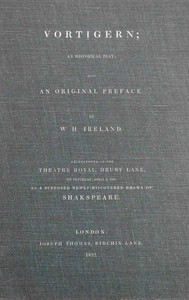
Vortigern; an historical play — Edition Insights can be approached with a clearer sense of reading commitment from its source measurements: 26,887 words, 1 hr 57 min estimated reading time, and 14 detected text sections.
The text analysis averages about 18.1 words per sentence, while the detected sections provide another way to judge how the source is divided.
Project Gutenberg metadata also associates the work with “Tragedies (Drama),” connecting these edition facts with the source record’s subject description.
Explore this collection
These alternatives are selected using recorded categories and estimated reading time.
About 118 minutes
Science Fiction Utopias
27,039 recorded words. 1 minutes difference from this book's estimate.
View Gutenberg source #6563About 120 minutes
Science Fiction Utopias
27,454 recorded words. 3 minutes difference from this book's estimate.
View Gutenberg source #47604About 113 minutes
Science Fiction Utopias
25,812 recorded words. 4 minutes difference from this book's estimate.
View Gutenberg source #875Search stored excerpts and compare books → Choose by your preferences →
Choices use stored catalog measurements. Estimates vary with reading speed. A shared category is a catalog label, not a claim that two books have the same argument or literary quality.
Search reads excerpt text stored with this catalog and links to its associated Gutenberg record. The connection is stored in the site database; this tool does not recheck that every excerpt is word-for-word identical to that external record. Excerpt search does not cover every chapter and does not verify historical publication dates.
Catalog snapshot checked: 2026-09-25. Coverage: 94 public books, 94 available source excerpts.
Read the complete public-domain text at its original source.
Read on Project GutenbergW. H. Ireland's 1832 preface to Vortigern; an historical play immediately confronts the work's notoriety. He notes that while the title is widely known, few have actually read the play, and he recounts the difficulty of obtaining a copy after nine years abroad. This framing turns the edition into a vehicle for self-vindication, as Ireland reflects on his "Shaksperian fabrications" and the persecution he endured for over thirty years. The preface thus sets the stage for a reading that is as much about the play's contested origins as its dramatic content.
Ireland's preface is not a conventional introduction to a historical drama. He explicitly states that he acquiesces to republication "more for the purpose of seizing an opportunity of saying something in vindication of myself, than from any desire to give fresh publicity to these dramas." This defensive posture colors the entire text. He references his 1805 Confessions but claims his feelings have since changed, suggesting a desire to reshape his legacy. Readers should note that the preface provides the author's perspective on the forgery controversy, but it does not offer a critical analysis of the play itself. The tone is personal and aggrieved, with phrases like "the shafts of persecution have been so relentlessly levelled against me" revealing Ireland's sense of enduring injustice.
The play opens with Aurelius and Uter, sons of the murdered King Constantius, receiving news of their father's death. The messenger implicates Vortigern, who has "laid the murder" on the Scots and assumed rule. The dialogue is formal and expository: Aurelius exclaims "Oh! horror! horror! my dear father murder'd!" and Uter urges "courage, my dear brother!" The verse relies on predictable rhythms and stock phrases, such as "the jewel of my soul" and "this hellish act." The scene quickly establishes a political conspiracy, with Vortigern's ambition and the brothers' need for revenge driving the plot. The setting shifts from Rome to Britain, and the characters' motivations are stated plainly, leaving little subtext for the reader to uncover.
In Act I, Scene III, the action moves to Vortigern's hall, where he is at supper with his wife Edmunda and son Wortimer. Vortigern's impatience is evident as he demands his other children attend him, and Edmunda attempts to soothe his "ruffled soul." His command "Peace, then; and with thy words, whet not, I pray, / That wrath, which kindles sore within my breast!" reveals a volatile ruler. The domestic scene contrasts with the political machinations of the earlier acts, but the characterization remains broad. Vortigern is portrayed as imperious and quick to anger, while Edmunda serves as a conciliatory figure. The excerpt does not yet show the full scope of the plot, but it hints at familial conflict that may parallel the larger power struggle.
For readers approaching Vortigern as a literary forgery, the play's language offers telling details. The verse lacks the metaphorical density and psychological depth of Shakespeare's work. Phrases like "my brimful heart would have ran o'er with sorrow" mix elevated diction with awkward grammar. The plot relies on direct exposition—messengers deliver news, characters state their emotions—rather than dramatic irony or soliloquy. Ireland's preface claims the play was accepted as Shakespearean in 1796, but modern readers will likely find the language stilted and the structure formulaic. Comparing the play's style to genuine Elizabethan drama reveals the limitations of Ireland's imitation, making the text a valuable case study in the history of literary hoaxes.
This edition pairs the play with Ireland's retrospective justification, inviting readers to consider both the work and its context. The excerpts suggest a straightforward historical tragedy, but the real interest lies in the gap between the play's modest literary merit and the scandal it provoked. Readers may wish to consult Ireland's Confessions for a fuller account, but the preface here provides a starting point for understanding the motivations behind one of literary history's most audacious forgeries.
Reading Ireland’s preface, I found myself thinking not of Shakespeare, but of another old play—one where a woman’s faith bends the story toward something unspoken. There’s a similar ache in Judith, a Play in Three Acts; Founded on the Apocryphal Book of Judith — A Reader’s Guide, that quiet gravity when history and invention meet. Both linger with me like half-remembered evenings.
Create a short personal record of your experience with this book.









