About 77 minutes
The Frogs — Text and Context
Fantasy Juvenile Worlds
17,551 recorded words. 10 minutes difference from this book's estimate.
View Gutenberg source #7998
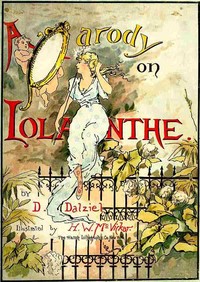
For A Parody on Iolanthe — Inside the Classic, the stored edition analysis reports 15,202 words, 1 hr 7 min estimated reading time, and 5 detected text sections.
The text analysis averages about 14.6 words per sentence, while the detected sections provide another way to judge how the source is divided.
Project Gutenberg metadata also associates the work with “Sullivan, Arthur, 1842-1900 -- Parodies, imitations, etc.,” connecting these edition facts with the source record’s subject description.
Explore this collection
These alternatives are selected using recorded categories and estimated reading time.
About 77 minutes
Fantasy Juvenile Worlds
17,551 recorded words. 10 minutes difference from this book's estimate.
View Gutenberg source #7998About 77 minutes
Fantasy Juvenile Worlds
17,679 recorded words. 10 minutes difference from this book's estimate.
View Gutenberg source #7700About 77 minutes
Fantasy Juvenile Worlds
17,624 recorded words. 10 minutes difference from this book's estimate.
View Gutenberg source #40729Search stored excerpts and compare books → Choose by your preferences →
Choices use stored catalog measurements. Estimates vary with reading speed. A shared category is a catalog label, not a claim that two books have the same argument or literary quality.
Search reads excerpt text stored with this catalog and links to its associated Gutenberg record. The connection is stored in the site database; this tool does not recheck that every excerpt is word-for-word identical to that external record. Excerpt search does not cover every chapter and does not verify historical publication dates.
Catalog snapshot checked: 2026-09-25. Coverage: 94 public books, 94 available source excerpts.
Read the complete public-domain text at its original source.
Read on Project GutenbergThis parody of Gilbert and Sullivan's Iolanthe transposes the fairy operetta onto the tracks of the Chicago & Alton Railroad, replacing the original's pastoral setting with a "fairy glade on the Chicago & Alton Railway, at Holy Cross, Illinois." The opening chorus, "Tripping always, tripping ever, / By each glen, each rock, each river," is immediately rerouted: the fairies must "twirl and twine / Round about the Alton line." The author, D. Dalziel, editor of the Chicago News-Letter, repurposes the libretto's structure to extol the railway's virtues, turning Leila's solo into a catalogue of Pullman Palace sleeping cars and the line's connections between Chicago, Kansas City, and Alton.
The parody's diction oscillates between fairy-tale formality and the vernacular of 1880s railway advertising. The Fairy Queen, for instance, speaks of commuting Iolanthe's sentence "as much as a member of the State legislature loves a railway pass." This simile yokes legislative privilege to corporate boosterism, a recurring pattern. The fairies' complaints about Iolanthe's exile—"It must be damp there, and her chest was always delicate"—are met with the Queen's deadpan reply: "An Iowa railway is hardly the place to send a delicate chest." The humor relies on the reader's familiarity with both the original operetta's whimsy and the period's railroad rivalries. Dalziel consistently substitutes the supernatural with the commercial: the fairy queen's magic becomes the railway's schedule, and the characters' plights are measured in travel times and train comforts.
The dialogue serves dual purposes: advancing the parody while embedding promotional copy. When Leila declares Iolanthe "was a whole team, and, like the Alton Road, she was the only one in the crowd who carried a proper train," the metaphor equates personal worth with railway service. Later, the Deacon Fitney sequence—a separate narrative thread—uses a child's gratitude to praise the Michigan Central Limited Express. Little Adele's exclamation, "How good of you to bring us to such a nice place, and by such a delightful road," is immediately undercut by the Deacon's correction: the Michigan Central is "the only direct road running to the Falls." The characters' voices are indistinguishable from the railway's own publicity, their enthusiasm a ventriloquized endorsement.
The book's structure mirrors a railway timetable, with the parody's acts interspersed with detailed schedules and route descriptions. The excerpt includes a full timetable for Train No. 10, the "Fast New York Express," listing departure and arrival times for stations from Chicago to Boston. This typographical shift from verse to tabular data enacts the collision of genres: the fairy world's timelessness is regimented into columns of hours and minutes. The parody's own scenes are similarly punctuated by the conductor's "all aboard," and the narrative pauses for the train's movements. The effect is a hybrid text where the operetta's dramatic rhythm is subordinated to the railway's operational logic.
The setting is not merely a backdrop but an argument for the railway's dominion. The fairy glade is "on the Chicago & Alton Railway," and the fields are "waving with already ripened grain that is going to take first prize at the next National Exhibition." This pastoral abundance is explicitly tied to the railroad's reach. The Cantilever bridge at Niagara is described as "the greatest scientific engineering effort of the age," and the Falls themselves are framed as a spectacle accessible only via the Michigan Central. Nature and industry are conflated: the fairies dance over wheat stocks, and the sublime view of Niagara is available "only" from the railway's station. The landscape is a corporate possession, its beauty a selling point.
Readers familiar with Gilbert and Sullivan's Iolanthe will recognize the parody's structural borrowings—the chorus of fairies, the banished fairy, the queen's clemency—but Dalziel's version is less a homage than a repurposing. The original's satire of British politics is replaced by boosterism for American railroads. The humor depends on recognizing the incongruity between fairy conventions and commercial rhetoric. This edition preserves the original illustrations by H. W. McVickar, which likely amplify the visual puns. Approach the text as a period artifact where advertising and parody are indistinguishable.
Leafing through that odd Chicago & Alton parody of Iolanthe, I kept thinking how the fairies there are so cheerfully bound to earthly rails and timetables—yet their magic still whispers of bargains made. It reminded me, quietly, of a different, darker pact. There is something achingly human in both, trading something intangible for a promised speed, a brief glory. That old echo surfaced again with The Tragical History of Doctor Faustus From the Quarto of 1604 — Key Ideas to Explore, and I simply sat with that thought for a while.
A brief reflection can help important ideas stay with you longer.









