About 77 minutes
The Frogs — Text and Context
Fantasy Juvenile Worlds
17,551 recorded words. 0 minutes difference from this book's estimate.
View Gutenberg source #7998
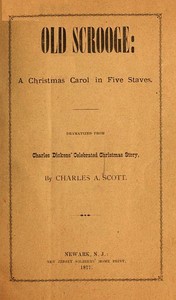
"Old Scrooge": A Christmas Carol in Five Staves. Dramatized from Charles Dickens' Celebrated Christmas Story. — Context and Discussion can be approached with a clearer sense of reading commitment from its source measurements: 17,624 words, 1 hr 17 min estimated reading time, and 3 detected text sections.
The text analysis averages about 11.6 words per sentence, while the detected sections provide another way to judge how the source is divided.
Project Gutenberg metadata also associates the work with “Misers -- Drama,” connecting these edition facts with the source record’s subject description.
Explore this collection
These alternatives are selected using recorded categories and estimated reading time.
About 77 minutes
Fantasy Juvenile Worlds
17,551 recorded words. 0 minutes difference from this book's estimate.
View Gutenberg source #7998About 77 minutes
Fantasy Juvenile Worlds
17,679 recorded words. 0 minutes difference from this book's estimate.
View Gutenberg source #7700About 67 minutes
Fantasy Juvenile Worlds
15,202 recorded words. 10 minutes difference from this book's estimate.
View Gutenberg source #46001Search stored excerpts and compare books → Choose by your preferences →
Choices use stored catalog measurements. Estimates vary with reading speed. A shared category is a catalog label, not a claim that two books have the same argument or literary quality.
Search reads excerpt text stored with this catalog and links to its associated Gutenberg record. The connection is stored in the site database; this tool does not recheck that every excerpt is word-for-word identical to that external record. Excerpt search does not cover every chapter and does not verify historical publication dates.
Catalog snapshot checked: 2026-09-25. Coverage: 94 public books, 94 available source excerpts.
Read the complete public-domain text at its original source.
Read on Project GutenbergCharles A. Scott's 1877 dramatization of A Christmas Carol is a stage adaptation that transforms Dickens's prose into a five-stave play. The script opens with a detailed cast list of twenty-four characters, including minor roles like Old Baldhead the fiddler and the pawnbroker Old Joe, and suggests doubling to reduce the cast to fifteen males and nine females. The title page notes the edition is "printed for the convenience of rehearsal" and allows the owner to make alterations, signaling a practical, performance-oriented document.
Scott provides precise costume descriptions for each character, which serve as shorthand for their social standing and personality. Scrooge's first dress is a "Brown Quaker-cut coat, waistcoat and pants" with a "low-crowned, broad-brimmed hat" and "bald wig with tufts of white hair on each side," evoking a stern, old-fashioned miser. Bob Cratchit wears a "long-tailed business coat of common material, much worn, and buttoned up to the neck," with a "large white comforter" and "narrow-rimmed silk hat, old style and the worse for wear." The Ghost of Marley appears in "drab cut-away coat and breeches" with a "gray, long-haired wig, with queue" and "shaggy eyebrows," while the Spirit of Christmas Past wears a "white tunic trimmed with flowers" and a "jeweled star for forehead." These details not only guide costumers but also reinforce the moral and emotional register of each figure.
Scott expands the comic potential of Dickens's story, particularly in the guessing-game scene at Fred's party. The dialogue becomes a rapid-fire exchange: Fred describes his subject as "a bear" that "lives in London, and walks about the streets, and is not made a show of," prompting guesses of pig, tiger, dog, cat, and monkey before Julia exclaims, "It's your uncle Scro-o-o-oge!" Mrs. Mangle quips, "It is hardly fair, you ought to have said yes, when I said, it's a bear." This scene, which in Dickens is brief, is here extended into a set piece that highlights the family's merriment and Scrooge's isolation. Similarly, the business friends' conversation after Scrooge's death is laced with cynical humor: Fatchin yawns that he doesn't know who inherited the money, and Redface insists on a lunch before attending the funeral. These additions give the minor characters more voice and create a sharper contrast with Scrooge's earlier severity.
Scott's stage directions emphasize visual and physical action. Scrooge's encounter with the Ghost of Christmas Yet to Come is rendered with explicit blocking: "Scrooge crosses stage, as if following Spirit to tormentor entrance, and remains while the scene changes." The Spirit is described as "shrouded in a black garment, which conceals its head, its form, its face, and leaves nothing visible save one outstretched hand." This theatrical choice makes the ghost a silent, pointing figure, increasing its ominous effect. The script also includes cues for scene changes, such as "CURTAIN" and "SCENE II.— A Street," indicating a production with multiple sets. The final stave likely includes the tableau of Ignorance and Want, as the cast lists "Six or eight children for tableaux." These elements show Scott adapting Dickens's descriptive prose into concrete, stageable moments.
Scott retains much of Dickens's dialogue but occasionally alters phrasing for the stage. Scrooge's speech to the Ghost of Christmas Yet to Come is nearly verbatim from the original: "Ghost of the Future, I fear you more than any spectre I have seen; but as I know your purpose is to do me good, and as I hope to live to be another man from what I was, I am prepared to bear you company." However, Scott adds a line not in Dickens: "Lead on! Lead on! The night is waning fast, and it is precious time to me, I know." This repetition of "Lead on" heightens the urgency and gives the actor a stronger cue. The moral weight of the story is carried through such direct address, but Scott also lightens the tone with comic asides, as when the business friends joke about the funeral. The adaptation thus balances Dickens's earnestness with Victorian stage conventions of broad comedy and spectacle.
Scott's dramatization offers a window into how Victorian theatre makers adapted popular fiction for the stage. Readers interested in performance history will note the practical choices—doubling, costume notes, and rehearsal license—that shaped the production. The script preserves Dickens's core moral arc while amplifying comic and theatrical elements, making it a distinct work that rewards comparison with the original story.
Some evenings I recall the fuss of staging that old Scrooge, how every whisper had to land just so. It reminds me of another play, one where words trip over themselves like competing heartbeats. Both share that quiet knowing—that love, for all its noise, survives on missteps and mercy. A gentle shelf-neighbor, that one: The Rivals: A Comedy — Inside the Classic.
A brief reflection can help important ideas stay with you longer.









