About 71 minutes
The Merry Devil of Edmonton — Context and Discussion
Adventure Picaresque Fiction
16,122 recorded words. 2 minutes difference from this book's estimate.
View Gutenberg source #4774
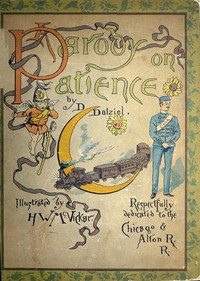
This digital edition of A Parody on Patience — Themes and Context is described by source-level measurements including 15,781 words, 1 hr 9 min estimated reading time, and 5 detected text sections.
The text analysis averages about 13.3 words per sentence, while the detected sections provide another way to judge how the source is divided.
Project Gutenberg metadata also associates the work with “Sullivan, Arthur, 1842-1900 -- Parodies, imitations, etc.,” connecting these edition facts with the source record’s subject description.
Explore this collection
These alternatives are selected using recorded categories and estimated reading time.
About 71 minutes
Adventure Picaresque Fiction
16,122 recorded words. 2 minutes difference from this book's estimate.
View Gutenberg source #4774About 73 minutes
Adventure Picaresque Fiction
16,774 recorded words. 4 minutes difference from this book's estimate.
View Gutenberg source #3012About 63 minutes
Adventure Picaresque Fiction
14,451 recorded words. 6 minutes difference from this book's estimate.
View Gutenberg source #1496Search stored excerpts and compare books → Choose by your preferences →
Choices use stored catalog measurements. Estimates vary with reading speed. A shared category is a catalog label, not a claim that two books have the same argument or literary quality.
Search reads excerpt text stored with this catalog and links to its associated Gutenberg record. The connection is stored in the site database; this tool does not recheck that every excerpt is word-for-word identical to that external record. Excerpt search does not cover every chapter and does not verify historical publication dates.
Catalog snapshot checked: 2026-09-25. Coverage: 94 public books, 94 available source excerpts.
Read the complete public-domain text at its original source.
Read on Project GutenbergThis parody of Gilbert and Sullivan's Patience transposes the aesthetic conflict of the original to a Chicago railway excursion to Niagara Falls. The opening pages establish a bustling domestic scene: Mr. Trevellyan, a stock broker, organizes a family holiday with the button-obsessed Deacon Fitney. The narrative voice is chatty and parenthetical, as when it remarks that family discussions 'generally involve more or less of that sort of thing.' The parody's setting is distinctly Midwestern and commercial, with the Michigan Central Limited Express described as a 'magnificent train' composed of sleepers, coaches, a palace dining car, and baggage cars.
The parody replaces the aesthetic poets of the original with a single comic peculiarity: Deacon Fitney's 'unreasonable fondness for Buttons.' The narrator notes that he 'adorned his apparel with more buttons than even the law requires,' including a 'nice gold headed button on his neatly tied satin scarf.' This substitution reduces the high-flown aestheticism of Gilbert and Sullivan to a mundane, almost absurd fixation. The Deacon's button mania is presented as an unexplained quirk—'nobody could ever find out what prompted this peculiarity'—which mirrors the inexplicable devotion of the original's aesthetic characters while grounding it in a trivial, material detail.
The parody is saturated with the language of railroad promotion. The Deacon declares the Michigan Central Railroad 'the only way to go,' promising to explain its advantages on the train. The text itself is punctuated by advertisements for railway supplies: the Baragwanath 'Steam Jacket' Feed Water Heater, the Hewitt Box Lid, and the Gardner Perforated Settees for passenger depots. These ads, printed alongside the narrative, create a collage of commercial enthusiasm that mirrors the parody's own promotional energy. The train is not merely a setting but a spectacle of industrial progress, with its 'five sleepers, three coaches, a palace dining car and a couple of baggage cars' enumerated like inventory.
The text's structure is itself a parody of Victorian publishing conventions. The narrative is interleaved with full-page advertisements for Chicago businesses—Marshall Field & Co., Palmer, Fuller & Co., and the Chicago Malleable Iron Co.—that seem to have no connection to the plot. This juxtaposition creates a tension between the fictional excursion and the real commercial world of 1880s Chicago. The ads, with their detailed claims about paint, heaters, and box lids, read as a second, parallel text. The parody thus becomes a hybrid: part theatrical burlesque, part railroad brochure, part city directory. The reader must navigate between the story of the Trevellyan family and the relentless promotion of local industry.
Readers familiar with Gilbert and Sullivan's Patience will find the parody's substitutions instructive: the aesthetic poet replaced by a button-loving deacon, the pastoral setting exchanged for a railway car. But the work also rewards attention to its material context—the advertisements and boosterish asides that frame the narrative. The parody is as much about Chicago's commercial ambition as it is about musical comedy.
It's funny, the things that stay with you. I read that Niagara parody once—all that shiny railroad hustle wrapped around something so delicate—and later, wandering through An Apology for the Life of Mr. Colley Cibber, Volume 1 (of 2) Written by Himself. A New Edition with Notes and Supplement — Themes and Context, I felt the same quiet ache: the performances we put on, just to keep moving forward.
Use these questions to collect your thoughts before moving on.









