About 49 minutes
A Proposal Under Difficulties: A Farce — Key Ideas to Explore
Adventure Picaresque Fiction
11,235 recorded words. 7 minutes difference from this book's estimate.
View Gutenberg source #37140
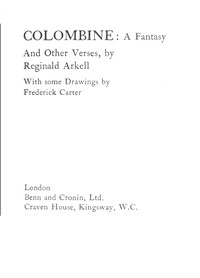
Before opening Colombine — Story, Setting & Ideas, the edition data offers a quick orientation: 9,451 words, 42 min estimated reading time, and 24 detected text sections.
The text analysis averages about 15.2 words per sentence, while the detected sections provide another way to judge how the source is divided.
Project Gutenberg metadata also associates the work with “One-act plays,” connecting these edition facts with the source record’s subject description.
Explore this collection
These alternatives are selected using recorded categories and estimated reading time.
About 49 minutes
Adventure Picaresque Fiction
11,235 recorded words. 7 minutes difference from this book's estimate.
View Gutenberg source #37140About 63 minutes
Adventure Picaresque Fiction
14,451 recorded words. 21 minutes difference from this book's estimate.
View Gutenberg source #1496About 69 minutes
Adventure Picaresque Fiction
15,781 recorded words. 27 minutes difference from this book's estimate.
View Gutenberg source #48723Search stored excerpts and compare books → Choose by your preferences →
Choices use stored catalog measurements. Estimates vary with reading speed. A shared category is a catalog label, not a claim that two books have the same argument or literary quality.
Search reads excerpt text stored with this catalog and links to its associated Gutenberg record. The connection is stored in the site database; this tool does not recheck that every excerpt is word-for-word identical to that external record. Excerpt search does not cover every chapter and does not verify historical publication dates.
Catalog snapshot checked: 2026-09-25. Coverage: 94 public books, 94 available source excerpts.
Read the complete public-domain text at its original source.
Read on Project GutenbergThe volume opens with a one-act fantasy set on Cissbury Beacon in the South Downs, where a fairy ring occupies the foreground and beech trees surround a Roman camp. The prologue immediately establishes a dual perspective: the circles of green where "Pharisees dance" and the circles of beech hiding "memories, lingering still, / Of Rome's indisputable sway." This layering of ancient and modern, rural and urban, recurs throughout the play and the verses that follow.
The play itself begins with a slow, dialect-rich exchange between two labourers, Dan'l and Nathan'l, whose conversation about tea and a story from "Tranter's Barn" gradually reveals a folkloric explanation for human troubles: all worries were locked in a box at the world's beginning, but a foolish soul gave the key to a maid. The structure thus moves from the mundane to the mythical, a pattern that echoes in the subsequent poems.
The play's setting is not merely decorative; it is a structural device. The fairy ring, the Roman camp, and the beech trees create concentric circles of time—prehistoric, Roman, and contemporary. The prologue's couplets contrast the supernatural ("Pixy-led folk who stray") with the mundane ("here, in Haymarket, the roadway is up"). This juxtaposition of ancient and modern is reinforced by the dialogue: Dan'l's yarn about a box of troubles is framed as something he read "in a story-book years ago," yet he delivers it in Sussex dialect, grounding the myth in local speech.
The play's brevity (a single scene at evening) and its reliance on two characters talking rather than acting make it more a dramatic poem than a conventional play. The fairy ring remains empty; the promised dance never occurs. Instead, the action is entirely verbal, with the past and the supernatural invoked through storytelling rather than spectacle.
The poem "The Marionette" explicitly states a theme that runs through the volume: "Man is merely a marionette / On invisible wires suspended." The image of the puppet controlled by a showman—"Fate"—recurs in the play's structure, where the characters seem to be reciting predetermined lines. The poem's three stanzas each end with a reminder of human limitation: "Till suddenly he's reminded," "Till suddenly he's reminded," and "On a problematical morrow." This refrain-like repetition mirrors the play's circularity.
Other poems reinforce this sense of mechanical fate. In "Love, Laughter, and After," a sequence of scenes—from a "ruinous cottage" to a "gay Casino" to a "pitiful pageant" and a "river that ends it all"—suggests an inevitable decline. The poem's structure, a list of snapshots, implies that the outcome is fixed from the start.
Arkell uses dialect not merely for local colour but as a marker of perspective. Dan'l and Nathan'l speak in Sussex dialect ("Do ee, lad?", "I sid in a story-book"), while the prologue and the other verses use standard English. This shift creates a distance between the rural characters and the urban reader, a distance that the prologue itself acknowledges: "You're lighting your pipe in the Charing Cross Road."
The dialect poems in the "Other Verses" section—such as "Th' Coortin'" and "The Explanation"—continue this pattern. In "Th' Coortin'," the speaker's dialect ("I axed Kate why ur an' Joe / Was seed together waalking out") contrasts with the poem's sophisticated emotional insight: "Ye'd better wed wi' one ye doan't / Than waalk wi' one ye do, as woan't." The dialect thus becomes a vehicle for expressing complex feelings in a seemingly simple form.
Several poems are structured as letters or memoranda, emphasizing absence and incompleteness. "A Letter from Home" begins with the mundane ("they're cutting the trees in the Priory Wood") and ends with a devastating postscript: the girl who stayed at the Grange is dead and buried. The poem's power lies in its structure: the news is buried in a postscript, as if the writer cannot bear to state it directly.
"Memoranda" explicitly instructs the reader to "Set aside no page for me" and to scribble only a hurried line: "He was once a friend of mine." The poem's brevity and its focus on a single line of text mirror the volume's own fragmentary nature—a play that is more a sketch, verses that are snapshots rather than narratives. The final image, "a memory sweeter than / Many written pages can," suggests that the unwritten, the incomplete, is more powerful than the finished work.
The volume's movement between the play and the poems, between dialect and standard English, and between the rural and the urban creates a mosaic of voices and perspectives. Readers may find it useful to consider how the play's fairy ring—a circle that is both a stage and a boundary—functions as a metaphor for the entire collection: a space where the past and present, the supernatural and the everyday, are held in suspension. The poems reward attention to their structure, particularly the way they use repetition, lists, and framing devices to suggest forces larger than the individual speaker.
That play about the two men on the Beacon stayed with me for days — something about the old circle in the grass and how effortlessly the past presses against the present. It reminded me of another familiar yet strange world, where grave people speak only in bright, careful nonsense. There's a particular tenderness in that. The Importance of Being Earnest: A Trivial Comedy for Serious People — Inside the Classic feels like an old friend who already knows what I mean.
Capture what you thought, learned, and would like to remember.









