About 952 minutes
Shakespeare's Roman plays and their background — Text and Context
Adventure Picaresque Fiction
218,784 recorded words. 97 minutes difference from this book's estimate.
View Gutenberg source #69937
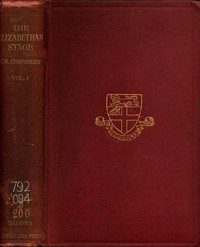
The catalog record for The Elizabethan Stage, Vol. 1 — Reading Companion provides practical reading context through 196,574 words, 14 hr 15 min estimated reading time, and 31 detected text sections.
The text analysis averages about 19.3 words per sentence, while the detected sections provide another way to judge how the source is divided.
Project Gutenberg metadata also associates the work with “Great Britain -- History -- Elizabeth, 1558-1603,” connecting these edition facts with the source record’s subject description.
Explore this collection
These alternatives are selected using recorded categories and estimated reading time.
About 952 minutes
Adventure Picaresque Fiction
218,784 recorded words. 97 minutes difference from this book's estimate.
View Gutenberg source #69937About 536 minutes
Adventure Picaresque Fiction
123,165 recorded words. 319 minutes difference from this book's estimate.
View Gutenberg source #44064About 403 minutes
Adventure Picaresque Fiction
92,671 recorded words. 452 minutes difference from this book's estimate.
View Gutenberg source #19028Search stored excerpts and compare books → Choose by your preferences →
Choices use stored catalog measurements. Estimates vary with reading speed. A shared category is a catalog label, not a claim that two books have the same argument or literary quality.
Search reads excerpt text stored with this catalog and links to its associated Gutenberg record. The connection is stored in the site database; this tool does not recheck that every excerpt is word-for-word identical to that external record. Excerpt search does not cover every chapter and does not verify historical publication dates.
Catalog snapshot checked: 2026-09-25. Coverage: 94 public books, 94 available source excerpts.
Read the complete public-domain text at its original source.
Read on Project GutenbergE. K. Chambers opens this first volume of The Elizabethan Stage by situating it as a second instalment of prolegomena, twenty years after The Mediaeval Stage, and acknowledges that his working life has been largely occupied with activities remote from letters. The preface, dated to the tercentenary of the First Folio, reveals a scholar constantly revising his chapters to incorporate new research, striving for reasonable completeness and consistency across drafts written at very different dates. Chambers is explicit that his investigation stops at Shakespeare's death, not carrying through to the closing of the theatres, a decision he calls irretrievable.
Chambers devotes his First Book to what he calls a perhaps disproportionate description of the Elizabethan Court and its ramifications in pageant, progress, tilt, and mask. He treats these not as mere decoration but as expressions of an instinct for spectacular mimesis inherited from the Middle Ages, of which the drama is the most important manifestation. The emphasis on courtly spectacle establishes a framework for understanding how the stage developed as an institution within the monarchical polity, rather than as an isolated literary phenomenon. Chambers's approach is archaeological, tracing the social and economic conditions that made such development possible.
The Second Book recounts the players' settlement in London and their conflict with Puritanism, backed by the Court. Chambers provides a detailed analysis of the stage's revengeful triumph over its critics, citing specific examples such as Jonson's Rabbi Zeal-of-the-Land Busy in Bartholomew Fair (1614), who scruples against eating pig at the fair as a spice of idolatry, yet eats two and a half to his share. The puppet's revelation that it has no sex refutes Busy's argument against cross-dressing. Chambers also notes that under James, the sting of caricature directly led to the renewal of the old controversy, with two hypocrites in The Puritan (c. 1606) christened after churches known as centres of Puritan faith. William Crashaw protested in a sermon at Paul's Cross, and Thomas Heywood responded with an Apology for Actors (c. 1608, published 1612), which Chambers describes as resuming effectively most arguments of the humanists and popular disputants, but contributing little novel.
To the Third and Fourth Books belong what Chambers calls the more pedestrian task of following in detail the fortunes of individual playing companies and theatres, with such fullness as the available records permit. The Fifth Book deals with surviving plays not in their literary aspect, which lies outside his plan, but as documents helping to throw light upon the history of the institution that produced them. This methodological choice—treating plays as evidence for institutional history rather than as works of art—shapes the entire volume. Chambers's tone is consistently modest and precise, acknowledging the limits of his investigation and the debt to predecessors whose work he builds upon.
Readers approaching this volume should expect a work of institutional history rather than literary criticism. Chambers's prose is dense with specific references to records, plays, and controversies, and he assumes familiarity with the broad outlines of Elizabethan theatre history. The preface's frank admission of the book's long gestation and the author's other preoccupations gives a human dimension to the scholarly apparatus. Those interested in the social and economic conditions of the stage, the court's role in shaping theatrical practice, or the Puritan controversy will find Chambers's detailed evidence invaluable.
Reading Chambers’ careful ledger of court revels and Puritan complaints, I remembered sitting in a cold library, tracing how a play survives its era’s quarrels. That same hush came over me later with Arms and the Man — Key Ideas to Explore, where ideals crack against gunfire and laundry. Both books, in their way, let me hold a distant struggle—spectacle versus sermon, romance versus mud—without needing to resolve it, just to witness.
Capture what you thought, learned, and would like to remember.









